
Technique
How to Stop Overreaching Your Boxing Punches
Use video, distance markers, and recovery tests to separate useful reach from a punch that leaves you unable to defend or move.

You are overreaching when the extra distance you chase prevents you from completing the next useful action. The clearest sign is not that you move your torso forward. Boxers transfer weight and change position when they punch. The useful question is whether you can finish balanced enough to defend, move, or punch again without an unplanned recovery step.
Do not use one frozen frame to declare that you leaned “too far.” Record the punch from setup through recovery and test what happens next.
Define the failed task
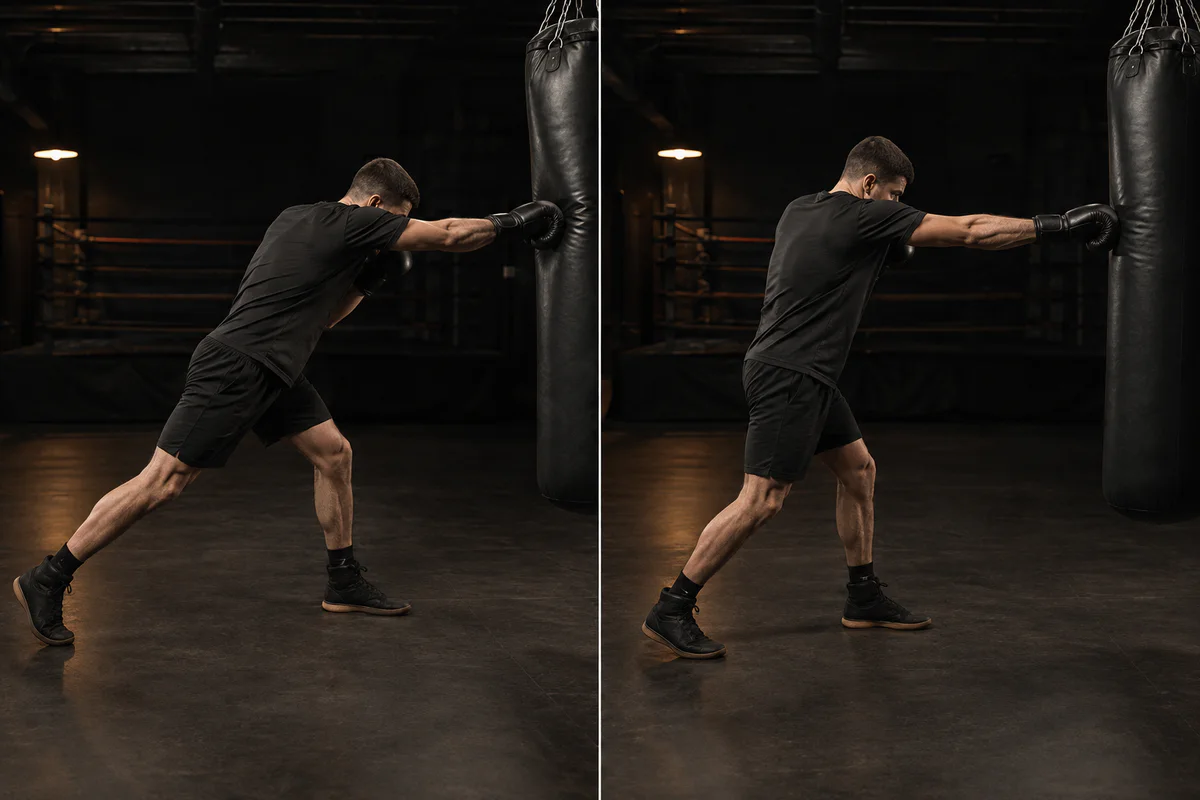
Judge reach by what you can do next. A useful finish lets you recover, defend, or exit without a rescue step.
Overreaching can describe several visible outcomes:
- You continue moving your head forward after you reach the farthest point with your glove.
- Your rear foot loses useful contact or drags unpredictably.
- You lengthen your stance so much that you need an extra adjustment.
- Your front knee and torso keep travelling after the punch finishes.
- You cannot exit, defend, or throw the planned follow-up on time.
Choose the outcome you can actually see. Avoid explanations such as “my core is weak” or “I lack confidence.” You cannot establish either cause from a clip.
In the IBA Coaches Manual, IBA instructors list incorrect weight shift, poor leg position, and leaning the head as common errors in basic punches. They also start with punches from a standing position before combining them with steps. Use that progression to find whether you lose control because of distance, the punch, or the step.
Record the whole action
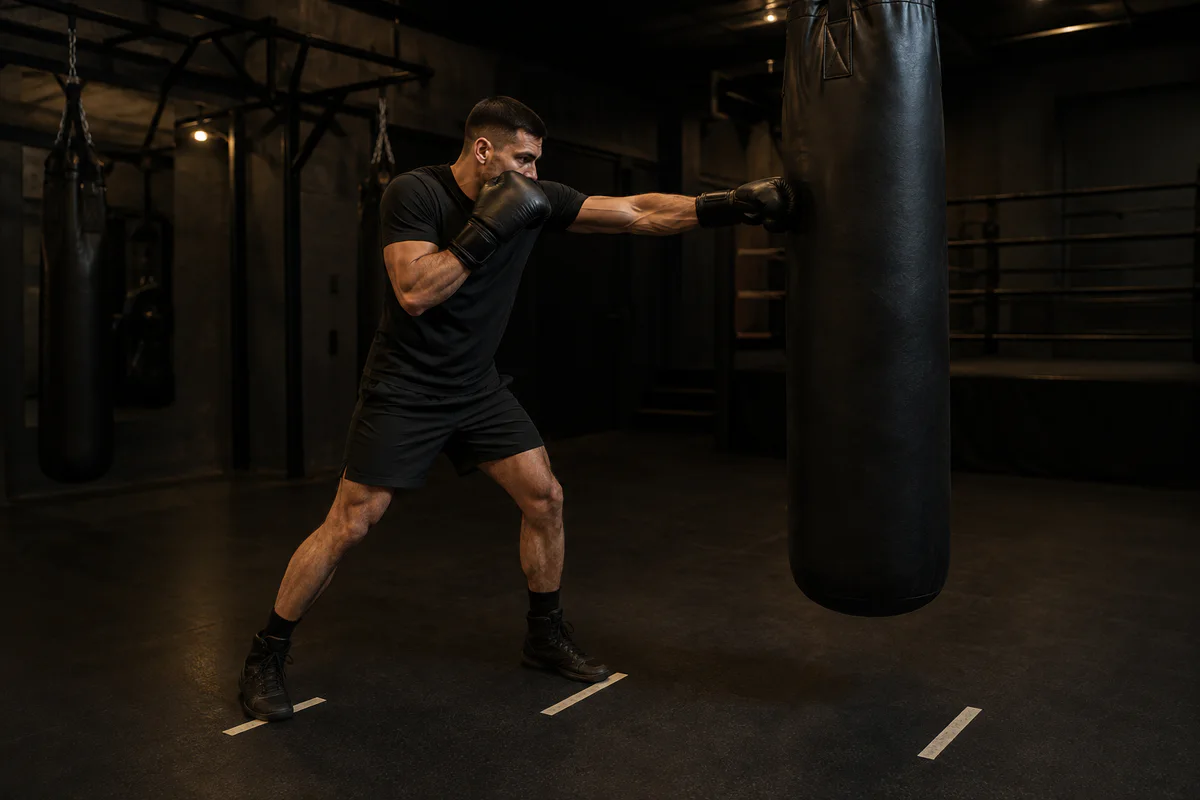
Mark the floor before both sets. The distance must stay stable before you compare your recovery.
Use a side or open 45-degree view. Frame your head, both gloves, hips, knees, and feet. Leave space between you and the target so you record your setup and recovery.
Place two removable floor references:
- One beside your lead foot at the start.
- One where you expect your lead foot to finish if you intentionally step.
Do not treat the markers as a universal stance prescription. They simply help you compare repeated attempts under the same task.
Pause the clip at setup, initiation, full extension, first recovery frame, and the moment you can act again. Follow the video-review methodology to separate visible evidence from interpretation.
Use the next-action test
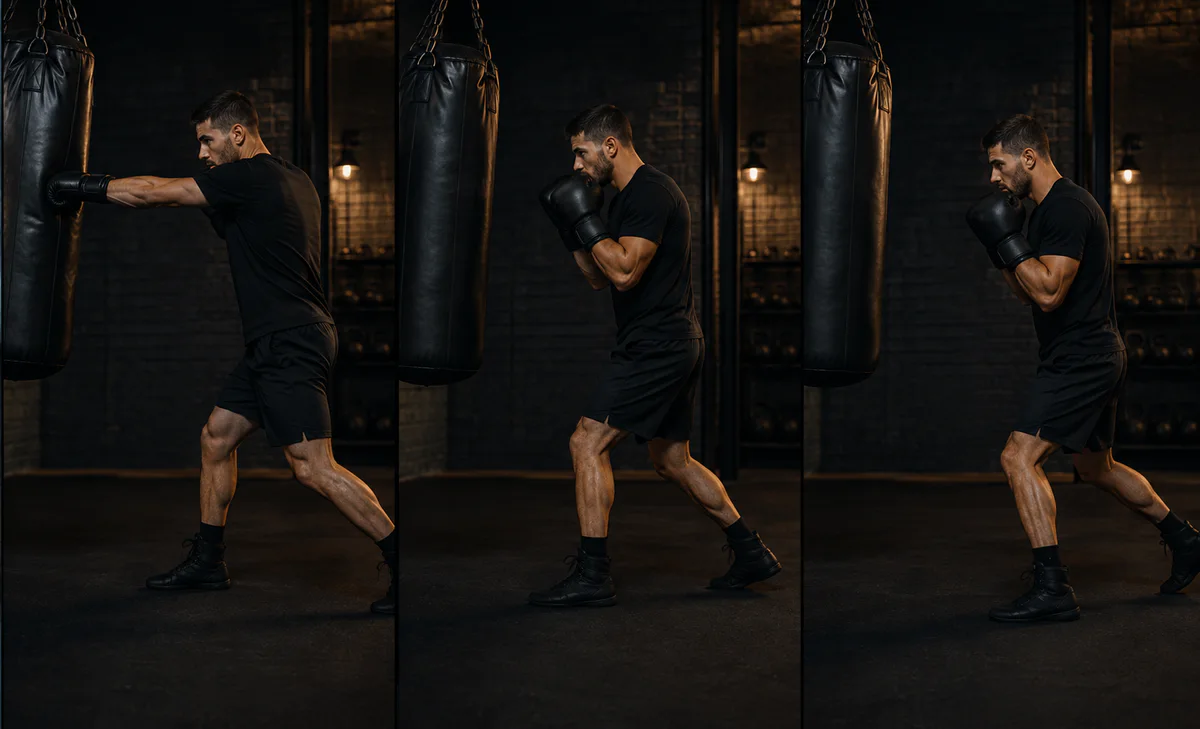
Review the extension, return, and exit as one action. Do not grade reach from the impact frame alone.
Plan one low-complexity action after the punch:
- Return both gloves to guard.
- Take one balanced step back.
- Exit one step to the side.
- Throw a second straight punch at controlled speed.
If you cannot perform the planned action without catching yourself, the first punch or its distance probably exceeded what you could control in that repetition. Use this test to define “overreaching” through function.
Separate three possible problems
The target is outside your standing range
Throw one rear straight without stepping. If you must project your head and torso to touch the bag, move closer or choose a stepping punch. Do not stretch a standing punch into a substitute for footwork.
The step is larger than you can organize
Practise the step without punching. Finish in a stance from which you can move in every direction. Then add the punch at lower speed. Use the existing footwork drill guide if your feet repeatedly finish too narrow, too long, or crossed.
You continue moving after the glove reaches the target
Reduce the target distance and the punch intensity. Use a visible stopping task: touch the target and recover before the bag swings back. Do not brace violently or lock yourself rigid. You are testing whether you can control the end of the action.
What biomechanics research adds
Researchers support a whole-body view of punching. In one comparison of the cross, hook, and uppercut in junior and elite boxers, researchers measured segment contributions, stability, force, and velocity with inertial sensors and force platforms. The authors reported coordinated contributions from the pelvis, trunk, shoulder, elbow, and wrist rather than a purely arm-driven action. Read the full biomechanical study.
In a newer study of lead and rear straight punches, researchers also described different speed and power characteristics between the hands and emphasized kinetic-chain transfer. Do not turn these laboratory findings into a phone-video formula for perfect weight distribution. Use them as a reason to check how you coordinate your feet, trunk, and arm instead of judging elbow extension alone.
A three-stage correction progression
Stage 1: Standing range
Choose a target you can reach without stepping. Throw three controlled singles. Finish each repetition in a stance you can hold briefly without another adjustment.
Stage 2: Step without punch
Start slightly farther away. Make one deliberate step into range, stop, and step out. Keep your stance organized. Ask your coach whether the distance and sequence fit the style they teach.
Stage 3: Step, punch, recover
Combine the step and punch. Plan the recovery before you start. Compare your first and last stance, then review the transition rather than demanding that the frames look identical.
Change only one variable between sets. If you alter distance, speed, target, step length, and instruction together, you cannot tell what fixed the problem.
Stop the drill if you feel pain, dizziness, confusion, vision changes, or unusual loss of coordination. Seek medical care when symptoms follow contact, persist, worsen, or concern you. The CDC concussion symptom guide explains the symptoms and danger signs that require urgent care.
Do not mistake tactics for a technical error
A boxer may intentionally commit weight, close distance, or finish in a different position. You cannot classify that choice from video without the drill objective, opponent context, and coach’s plan. Write the task at the start of the recording: “rear straight, then one step out.” Judge the repetition against that task.
Use Boxing AI to compare the recovery
You can use the app to review visible technique. You cannot use it to measure ground-reaction force from ordinary video, identify pain, or decide whether a committed punch was tactically correct.
Use a distance-and-recovery worksheet
Record one row for each set instead of relying on memory:
| Set | Standing or stepping | Target distance | Planned next action | Unplanned adjustment |
|---|---|---|---|---|
| A | Standing | Normal | Step back | Needed two recovery steps |
| B | Standing | Slightly closer | Step back | None in two of three attempts |
| C | Stepping | Coach selected | Exit left | To be reviewed |
Do not use the example to prescribe your distance. Use it to isolate a change. Use floor markers only to reproduce the test, and remove them when they create a tripping risk.
Bring your coach the normal-speed clip, the selected slow-motion segment, and the worksheet. Ask one decision question: “Did moving closer solve a distance error, or did I hide another problem?” With that question, you invite technical judgment without claiming that you diagnosed the cause from a camera view.
Retest the chosen correction on another day before increasing intensity. If you can recover only while consciously holding a pose, you have not shown that the change transfers to ordinary training. Ask your coach to progress from the isolated punch to a short combination, then to an appropriate tactical drill. Keep contact and fatigue outside the test until your coach decides they belong.
Your pass standard
You have not solved overreaching merely because you keep your torso upright. You have improved control when you can reach the intended target and complete the planned defensive or movement action across repeated controlled attempts.
Take that evidence to your coach before you increase speed, power, complexity, or contact.