
Technique
How to Fix a Wide Lead Hook: Range, Path, and Recovery
Review whether your lead hook has become an uncontrolled swing, then test a compact path without forcing one universal elbow angle.

A wide lead hook becomes a problem when you take an unintended long route, lose your defensive position, or cannot recover into the next action. Do not judge width from one frame. Hook shape changes with distance, target, style, and tactical purpose. First state that you intended to throw a compact lead hook at a specific range.
In the IBA Coaches Manual, IBA instructors distinguish straight punches, hooks, and uppercuts and introduce each punch from a stable stance. England Boxing gives coaches another structured reference in its Level 2 Coaching Handbook. Ask your coach which hook variation the drill requires.
Separate a wide hook from the wrong punch label
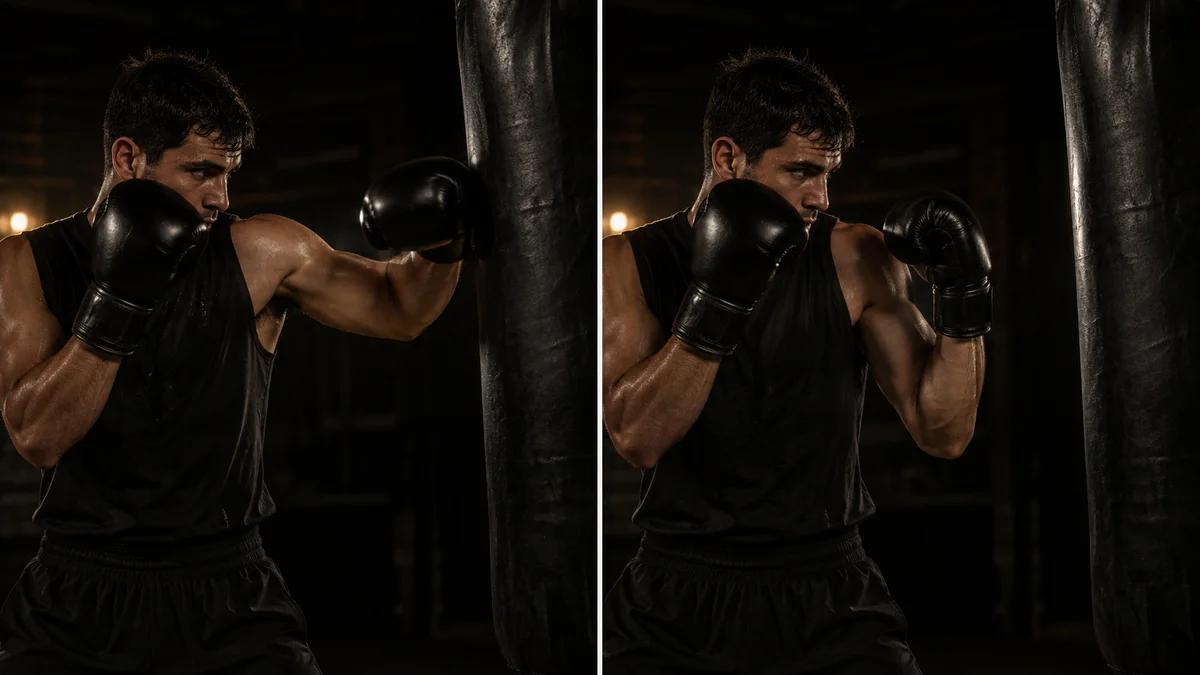
Define the hook variation and range before you call it wide. Compare the path without forcing one universal elbow angle.
Before you correct anything, check the task:
- Did you intend a lead hook, a long hook, or an overhand action?
- Did you target the head, body, bag side, or mitt angle?
- Did you start inside the intended range?
- Did the drill require a pivot, step, or stationary punch?
- What defensive or movement action had to follow?
If you cannot answer those questions, you cannot use the clip to prove that you chose the wrong arc.
Record three phases
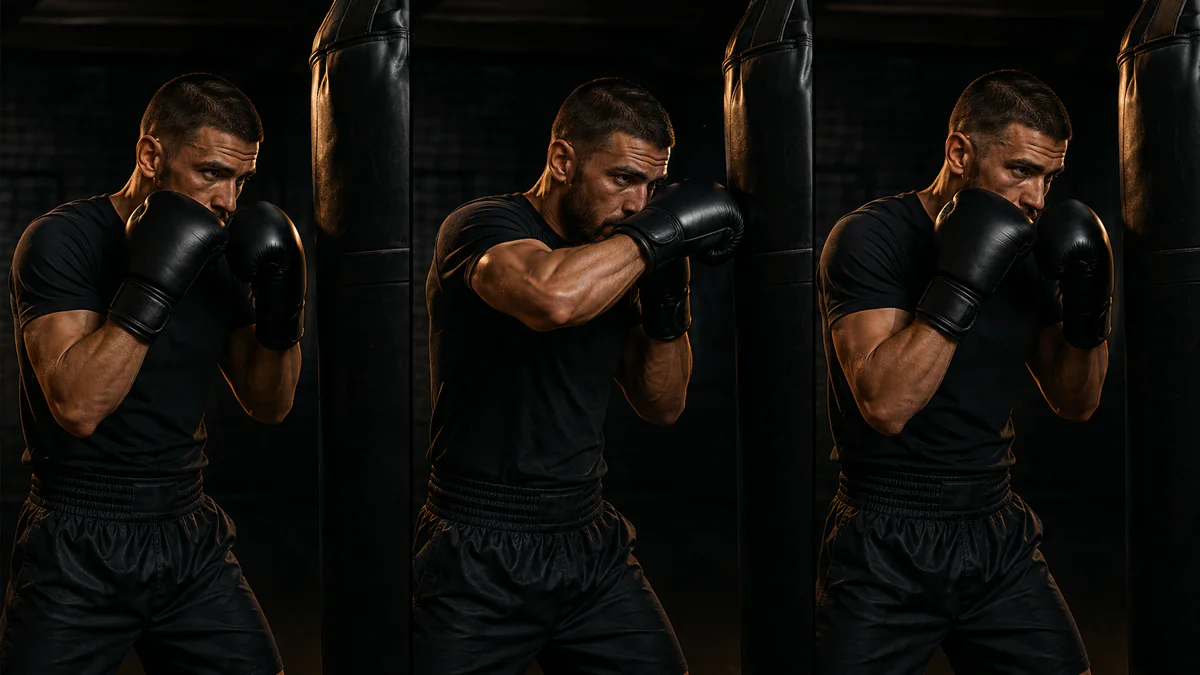
Record the start, contact phase, and finish. The return matters as much as the arc.
Use a front-side 45-degree view for the glove path and opposite-hand guard. Use a slightly elevated view only if you need to examine the horizontal arc. Keep your full stance in frame for at least one set.
Review:
- Entry: whether you pull the glove away from guard before the hook begins.
- Arc: whether you maintain a compact bent-arm action appropriate to the chosen range.
- Exit: whether you return to guard or continue rotating past your usable stance.
You cannot calculate punch force, shoulder torque, elbow load, or an ideal joint angle from ordinary footage. In a 2020 biomechanical analysis of the cross, hook, and uppercut, researchers measured three-dimensional movement, stability, and force with laboratory sensors. They found coordinated segment contributions and differences between junior and elite boxers. They did not produce one phone-video hook template for every athlete.
Find the earliest visible expansion
You pull the glove backward
Hold your starting guard briefly, then begin the hook without a visible wind-up. Use the task “short arc to the marker.” Do not tense every muscle to hide movement. Ask whether you removed the unnecessary detour.
You stand too far away
Move to a range your coach approves for the selected hook. A compact hook cannot solve a distance problem created before the punch. Test the punch without stepping, then add the intended footwork separately.
You straighten the arm as you chase the bag
Reduce reach and intensity. Use light contact or shadowboxing so you can preserve the selected shape. Do not force your elbow into discomfort. Stop if you feel pain.
You rotate past the target
Plan the recovery. Throw one controlled hook, return both gloves, and take one small exit. If you need to unwind first, reduce the arc or rotation with your coach’s help.
Use three comparison clips

Keep the range consistent between clips. A hook can look wider simply because you started too far away.
Clip A: Standing shadow hook
Throw three lead hooks without a target. Use a fixed visual point to keep the intended range consistent.
Clip B: Light bag touch
Move close enough to touch the bag without reaching. Keep the same camera and instruction. Do not turn a technical test into a power test.
Clip C: Jab-lead hook
Add one jab only after the solo hook stays organized. Check whether the jab leaves you too far away and causes the hook to widen.
Use the broad hook technique guide for the complete punch. Use this page to answer the narrower diagnostic query about an unintended wide path. Link back to the broad owner rather than repeating its whole lesson.
Review defense with the punch
A compact path does not help if you abandon every other requirement. Check whether you:
- keep the non-punching glove in the defensive position your coach set;
- preserve a usable chin and head position;
- finish balanced enough to defend or move;
- recover the lead glove without dropping it;
- maintain enough visual attention for the drill.
Use the page about keeping your rear hand up during a hook to isolate the non-punching-hand problem. Do not merge that diagnosis with hook width unless you make both changes consistently.
Compare fresh and later technical sets carefully
Researchers have reported that fatigue can reduce punch output and alter lower-body contributions, with larger effects for more rotational punches in some studies. Read the fatiguing lower-body study and the 2025 lower-limb kinetics study.
If your hook widens later in training, compare sets without assuming fatigue caused it. You may also have changed range, pace, target, or tactical intent. Keep those variables recorded. Never use a fatigued technical test as permission to continue through pain or loss of coordination.
Use Boxing AI for one hook question
You can use Boxing AI to review visible punch mechanics. You cannot use it to measure joint load, determine why you widened the hook, or replace a coach who can set the correct range and mitt position.
Give your coach a hook-range matrix
Test only ranges your coach approves and use technical intensity:
| Range condition | Declared hook | Visible question | Next decision |
|---|---|---|---|
| Standing, close enough to touch | Compact lead hook | Can you preserve the selected arc and recover? | Keep or simplify |
| One jab establishes distance | Jab to lead hook | Does the jab leave the hook at the intended range? | Adjust range, not shape |
| One planned step | Stepping lead hook | Does the step alter the arc before delivery? | Separate step and punch |
Do not use the matrix to compare power. Keep impact light enough that you can observe and repeat the task safely. Record the bag position before each set because a swinging target changes the apparent range.
Ask your coach whether the hook variation, target, and range match each other. Show one typical repetition, one failed repetition, and one revised repetition. Avoid presenting only your cleanest take.
If the coach selects a longer hook for a particular tactical job, create a new task record instead of marking it as a failed compact hook. Your dataset should preserve legitimate variation. That distinction matters if you later use the records to generate pages, prompts, or automated review criteria.
Your pass standard
Count your result as useful when you can reproduce the selected hook at the intended range, return to a defensive position, and complete the planned next action. Do not require every hook variation to look identical. Require each repetition to match the task you declared.
Keep normal-speed context with every selected slow-motion segment. Ask your coach to watch the full repetition first, then inspect the earliest frame where you changed the arc. This order preserves rhythm and intent. It also reduces the chance that you will treat one transitional frame as the complete hook.