
Footwork
How to Stop Crossing Your Feet in Boxing Footwork
Identify exactly where you cross your feet, rebuild one direction at a time, and verify your stance through a controlled video test.

If you cross your feet during basic boxing movement, do not practise every direction faster. Find the exact transition where you lose your stance, remove punches, and rebuild that one step. You may cross during a forward drive, backward retreat, lateral move, pivot, or direction change. Each transition needs a different correction.
The IBA Coaches Manual describes forward, backward, and lateral boxing steps while maintaining a usable stance. The England Boxing Level 2 Handbook provides another structured framework. Use those references without turning one written sequence into a universal style.
Define what you mean by crossing
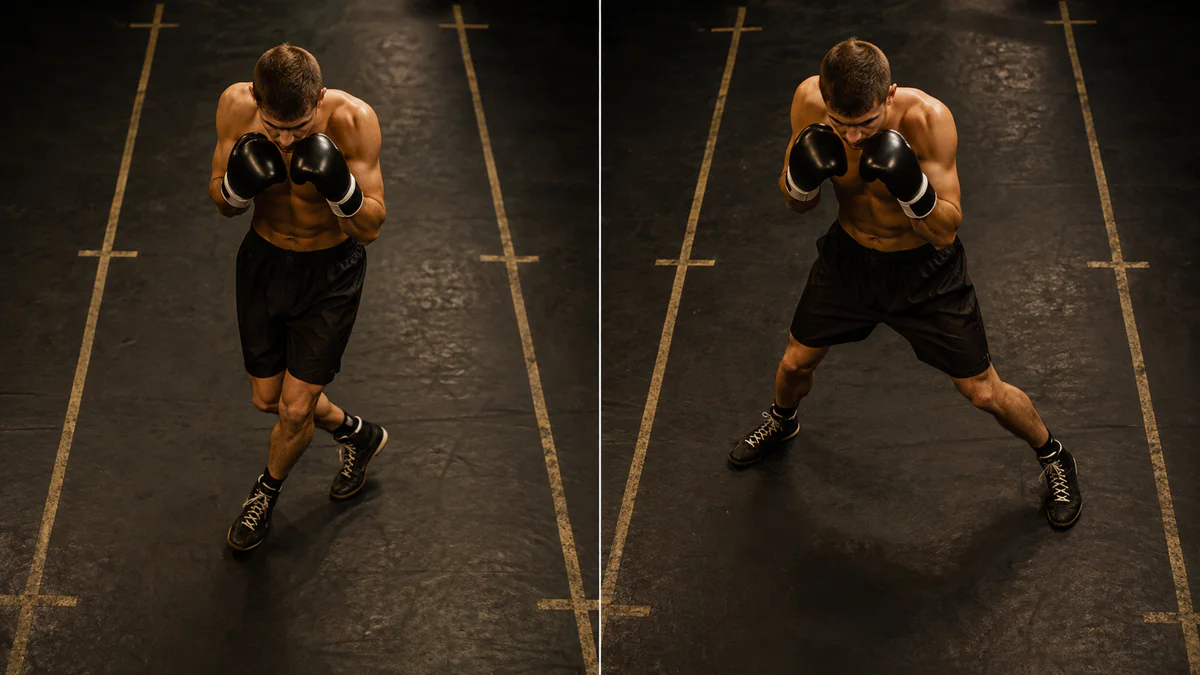
Name the direction and the exact transition. Do not label a whole round from one unfamiliar foot position.
Review the path each foot takes across the floor. Record whether you:
- place one foot directly across the path of the other;
- bring your feet together and lose the stance before the next step;
- switch lead and rear positions unintentionally;
- rotate without moving the second foot into a recoverable position;
- take an emergency recovery step after the intended movement.
Do not use “my footwork is bad” as your observation. Write the direction and moment: “When I moved right from my orthodox stance, I placed my left foot across my right-foot path in three of five attempts.”
Film from an angle that shows the floor
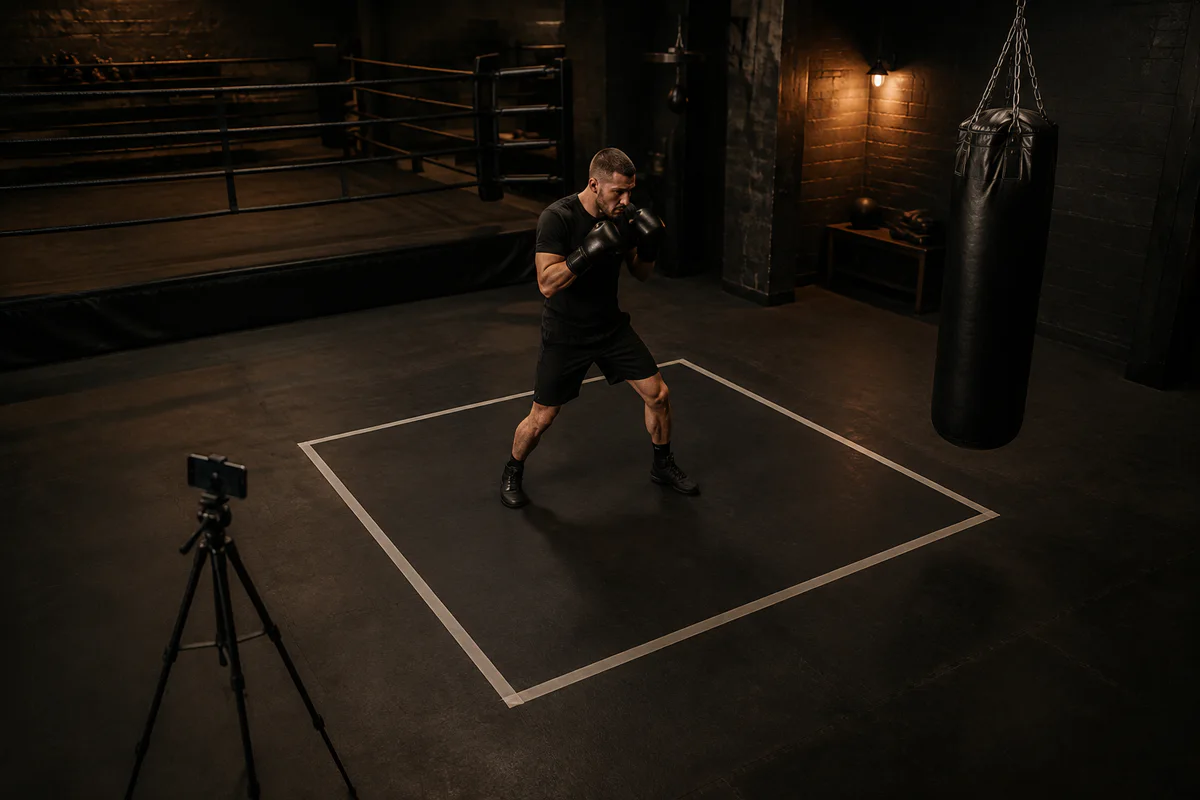
Place the camera outside your lane. Keep the full floor pattern and both feet in frame for every direction.
Place your camera high enough to capture your full body but low enough to keep your foot positions readable. Use a front-side 45-degree view for lateral steps. Use a side view for forward and backward movement. Record separate sets for separate angles.
Place a removable cross or small grid on the floor. The marks provide references, not required destinations. Wear footwear that contrasts with the floor and use enough light to avoid motion blur.
Follow the boxing filming guide to keep the entire movement inside the frame. If the bag or ropes hide a foot, move the camera before you evaluate the set.
Run the four-direction screen
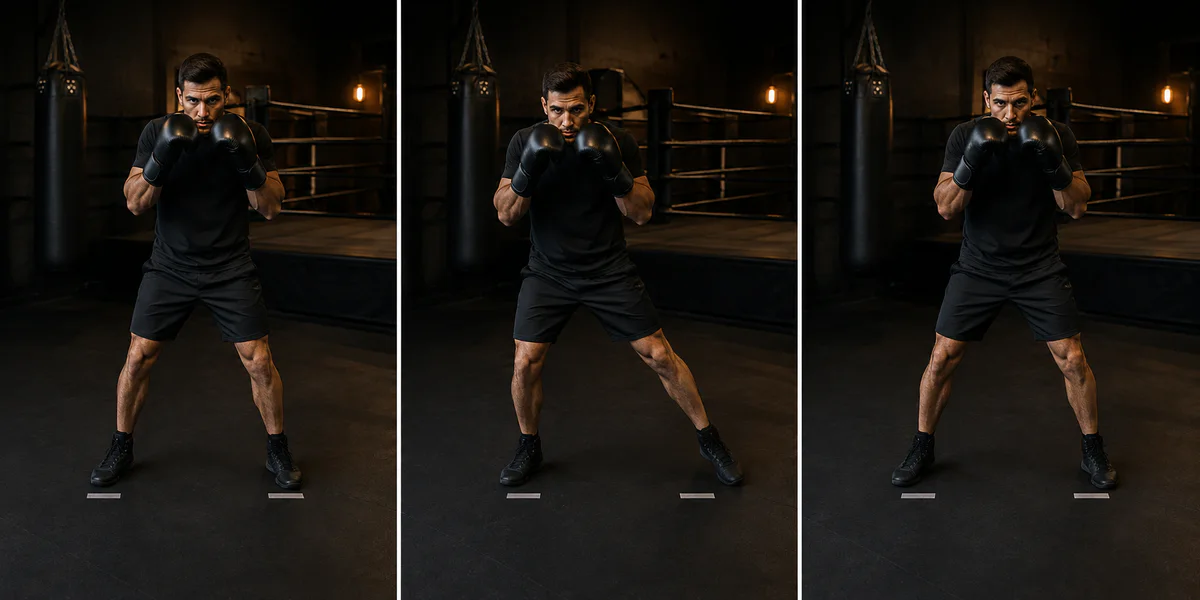
Test one direction at a time. The nearest foot starts, the other follows, and you finish ready to act again.
Start without punches. Make one deliberate step, settle, and return.
- Forward and back.
- Left and right.
- Quarter turn in each direction.
- One planned change of direction.
Repeat each task three times. Stop the set when you identify the first repeatable crossing pattern. Continuing through many poor repetitions gives you more footage but not a cleaner answer.
Match the correction to the direction
Forward movement
Test whether you reach with the front step and drag the rear step too late. Reduce the distance. Move into range, restore your stance, then move again. Do not add a jab until you can repeat the step.
Backward movement
Test whether you pull the front side back before you have created space with the rear side. Use one slow retreating step and pause in a usable stance. Keep the task small enough that you do not need a second emergency step.
Lateral movement
Name the direction relative to your stance. Ask your coach which side initiates the movement in the drill they teach. Practise one step rather than shuffling continuously. Check whether you preserve enough width to move again in either direction.
Pivot or turn
Separate rotation from travel. Practise a small coach-approved turn around a fixed point, then stop. If you rotate farther than you can organize, reduce the angle. Use the dedicated pivot-balance protocol for the narrower pivot problem.
Use a constraint instead of a slogan
“Never cross your feet” tells you what to avoid but not what to do. Give yourself a visible task:
- Keep one strip of floor visible between your shoes from this camera angle.
- Finish each step ready to move in the opposite direction.
- Stop after one step and hold the position briefly.
- Keep the step inside two floor markers chosen with your coach.
Use the constraint only when your coach considers it appropriate for the drill. Do not treat a strip of visible floor as a universal biomechanical law. When you change the camera angle, you change what you see.
Add a punch without hiding the movement
Once you can repeat the step alone, add one jab at controlled speed. Record whether you change the step because you chase the target. Then add one rear straight only if you preserve the planned sequence during the jab and step.
Use the boxing footwork drills page for the broader movement library. Use the boxing stance guide to establish a starting reference. Use this diagnostic page for one narrow problem: an unintended crossing transition.
Understand the evidence boundary
Researchers who study punching biomechanics have shown how boxers coordinate lower-limb forces with trunk and upper-limb movement. In the lead-straight study and the newer lower-limb kinetics study, researchers used laboratory equipment that you cannot reproduce with ordinary video.
You can use your clip to review step sequence, approximate stance width, direction, and recovery. You cannot use it to measure pressure under each foot, joint load, friction, or why you crossed. If you feel pain, dizziness, or unusual loss of coordination, stop training. Seek medical care when symptoms follow contact, persist, worsen, or concern you. The CDC concussion symptom guide explains the symptoms and danger signs that require urgent care.
Use Boxing AI for one direction
You can use Boxing AI to review visible stance and footwork. You cannot use it to measure forces through the floor, diagnose a balance problem, or decide which tactical movement your coach wants.
Record a direction-specific footwork card
Use one card for each direction:
Starting stance:
Direction:
Number of planned steps:
Required finish:
First visible crossing moment:
Repetitions affected:
One revision:
Coach decision:
Do not combine left and right movement under one “lateral footwork” result. Your sequence may change with direction, stance, target, and tactical purpose. Keep the cards separate until your coach identifies a shared cause.
Review normal speed first. Use slow motion to locate the crossing frame, but remember that it may make a brief narrowing look more dramatic than it felt. Mark the attempt inconclusive when you cannot see the floor clearly.
After you improve the isolated step, ask your coach to choose one progression: add a jab, add a direction change, or add a controlled cue. Do not add all three. Record whether the same crossing returns at the transition. If it does, remove the newest layer and repeat the previous task.
Recheck on another day and in both fresh and later technical work. Keep intensity controlled and record the session context. You want evidence that you can preserve the step sequence, not a promise that you will never cross during a live exchange.
Your pass standard
You pass the basic test when you can complete the chosen step and immediately move back, sideways, or into your coach-approved next action without an unplanned foot crossing or recovery shuffle. Confirm that result across repeated controlled attempts before you add speed, combinations, or partner pressure.
Save separate baselines for forward, backward, leftward, and rightward movement. Do not average them into one footwork score. If you control three directions and lose the fourth, keep the successful directions unchanged while you and your coach isolate the failed transition. By separating the records, you protect useful movement while revising one specific step.
Record the exact direction in every filename so you can retrieve the correct comparison later.