
Training
Boxing Drills at Home Without Equipment
Use six no-equipment boxing drills for stance, footwork, jab recovery, defense, combinations, and a complete 20-minute home session.
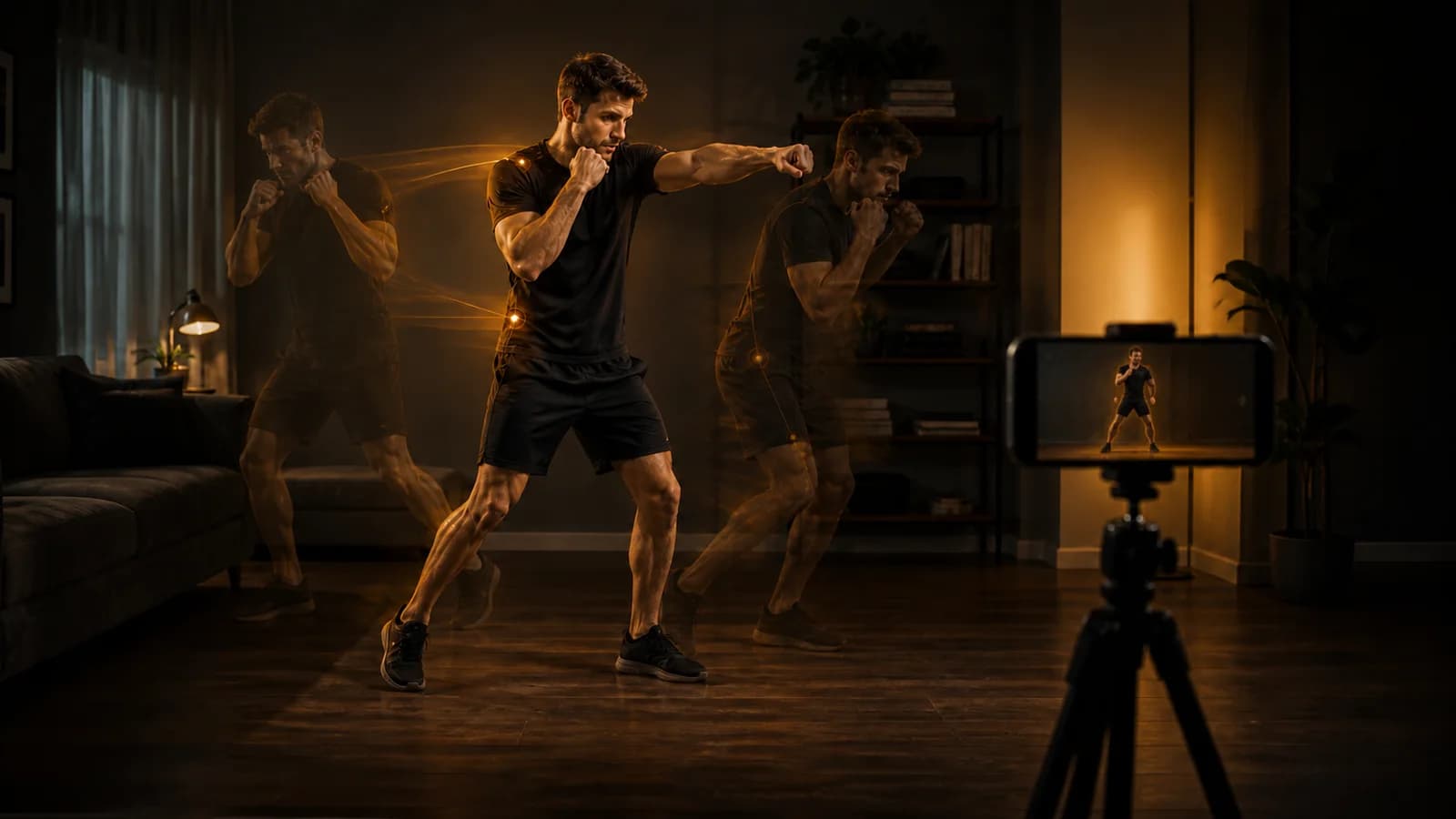
The most useful boxing drills at home without equipment are stance resets, step-and-return footwork, jab recovery, one-two-and-exit, defense-to-counter, and constrained shadowboxing. Put them into six 60-second rounds with 30–60 seconds of rest. Work at a speed that lets you finish balanced; shadowboxing becomes less useful when you throw as fast as possible without checking the return.
Clear roughly 6 × 6 feet of non-slip floor. Remove furniture, cables, pets, and breakable objects. You need only comfortable training clothes, suitable shoes if the floor requires them, and a clock you can see or hear. Do not strike walls, doors, or improvised targets.
The IBA Coaches Manual connects stance, movement, attack, and defense. These drills follow the same order. Each one begins from a usable stance and ends with a position from which you could defend or move again.
Drill 1: stance reset
Take your normal orthodox or southpaw position. Relax for a moment, then rebuild it from the floor upward: feet separated, knees comfortably bent, eyes forward, hands in a useful guard. Hold for two breaths, take one small step, and reset.
Repeat in four directions. Do not copy another boxer’s exact foot spacing; use the boxing stance guide to check whether your base lets you punch and move without an extra adjustment. This drill teaches you to recognize your position instead of relying on tape marks.
Drill 2: step and return
Choose an imaginary line on the floor. Start behind it, step across with the foot closest to your direction, then bring the other foot far enough to restore your stance. Reverse the movement. Continue forward and back for 20 seconds, then left and right.
Keep your feet from touching or crossing. Make each step small enough that you can stop midway. In the final 20 seconds, change direction when you hear a timer beep or say “change” aloud. Your goal is not distance; it is arriving balanced.
Drill 3: jab and guard return
Pick an imaginary target at realistic range. Throw one relaxed jab and bring the lead hand back before you move. Keep the rear hand available and avoid locking the lead elbow. Complete five clean repetitions, then add a small step with the jab.
Use the jab technique guide for the complete sequence. If your shoulder rises, your rear hand drops, or your weight continues beyond the lead foot, slow down. A clean return matters more than throwing another punch.
Drill 4: one-two and exit
Throw a controlled jab-cross, recover both hands, then take one short step out at an angle. Alternate exits to each side while keeping the combination simple. Pause after the exit and check whether your feet remain separated and your eyes still face the imaginary opponent.
Do not spin away or lean for extra reach. The round trains a sequence: enter, punch, recover, leave. If the cross pulls you forward, shorten the imagined distance and reduce the speed.
Drill 5: defense to one counter
Imagine one slow incoming jab. Choose a single response—parry, block, or small slip—then answer with one jab and reset. Repeat the same response for the entire round. On the next session, choose a different defense.
Keep the head movement compact. Deep, fast slips without a partner can teach you to overmove. A coach should show you how the defense fits your stance and rule set before you add speed or a longer counter.
Drill 6: constrained shadowboxing
Shadowbox for one minute with only three permitted actions: jab, step, and guard reset. In the next round, allow jab-cross, one defensive action, and one exit. Constraints stop you from hiding weak fundamentals inside random combinations.
Move around an imagined opponent rather than standing in front of a mirror. Finish every exchange in a position that lets you see, defend, and step again. Use the home-training system when you want to place these drills into a three-day week.
Follow this 20-minute session
- Warm up for four minutes with brisk walking, shoulder movement, ankle movement, and easy shadowboxing.
- Complete the six drills above for one minute each, resting 30 seconds between rounds.
- Rest two minutes and repeat the two weakest drills.
- Finish with two minutes of easy movement and write one task for next time.
Keep the first pass at conversational intensity. In the second pass, improve one detail rather than increasing every movement. The Boxing Session Builder can time the blocks and keep each round focused.
Avoid three common home-drill mistakes
First, do not throw every punch at maximum speed. Without a target or partner, speed can hide a lost base and a slow return. Second, do not invent ten-punch combinations. A beginner learns more from a repeatable two-action sequence. Third, do not watch only your hands. Your feet, balance, head position, and finish determine whether the whole action works.
The video form-check guide shows how to film from a front three-quarter or side angle. Compare clips only when the drill, angle, and approximate speed match.
Know when to stop or get coaching
No-equipment drills can build coordination, rhythm, basic footwork, and light conditioning. They cannot reproduce an opponent’s range, reactions, contact, or pressure. Do not improvise sparring at home. Learn partner drills, pad work, bag mechanics, and sparring in a reputable club with qualified supervision.
Stop for pain, dizziness, unusual shortness of breath, or feeling unwell. After any hit to the head, seek urgent medical guidance for headache, confusion, balance problems, vomiting, vision changes, or other concerning symptoms. The CDC HEADS UP guidance explains concussion signs; neither this workout nor an app can diagnose them.
Bottom line: choose six simple drills, keep the rounds short, recover your stance after every action, and review one visible checkpoint. You can practise useful boxing patterns without equipment, but qualified coaching remains essential for contact, tactics, and corrections you cannot verify alone.