
Technique
How to Stop Falling Forward After a Boxing Combination
Find which punch or distance change breaks your recovery, then rebuild the combination from a stable final action.

If you fall forward after a boxing combination, identify after which punch you first lose the ability to recover. Do not repeat the full sequence and hope that more speed fixes it. Split the combination, test the distance, and give the final punch a planned exit.
“Falling forward” should describe a visible failed task. You may project beyond a position you can control, chase a moving bag, take an unplanned step, or need to catch yourself before you can defend. State which outcome you recorded.
Write the combination and its required finish

Write the intended finish before you record. Keep the start distance fixed so you can identify the first broken transition.
Before recording, define the task:
Combination: jab, cross, lead hook
Target: heavy bag
Starting distance: one controlled step outside range
Required finish: both gloves return, then one step out
Intensity: technical, not maximal
Without that context, a reviewer cannot tell whether you intentionally entered, changed levels, or committed to a tactical finish.
Record from setup through exit
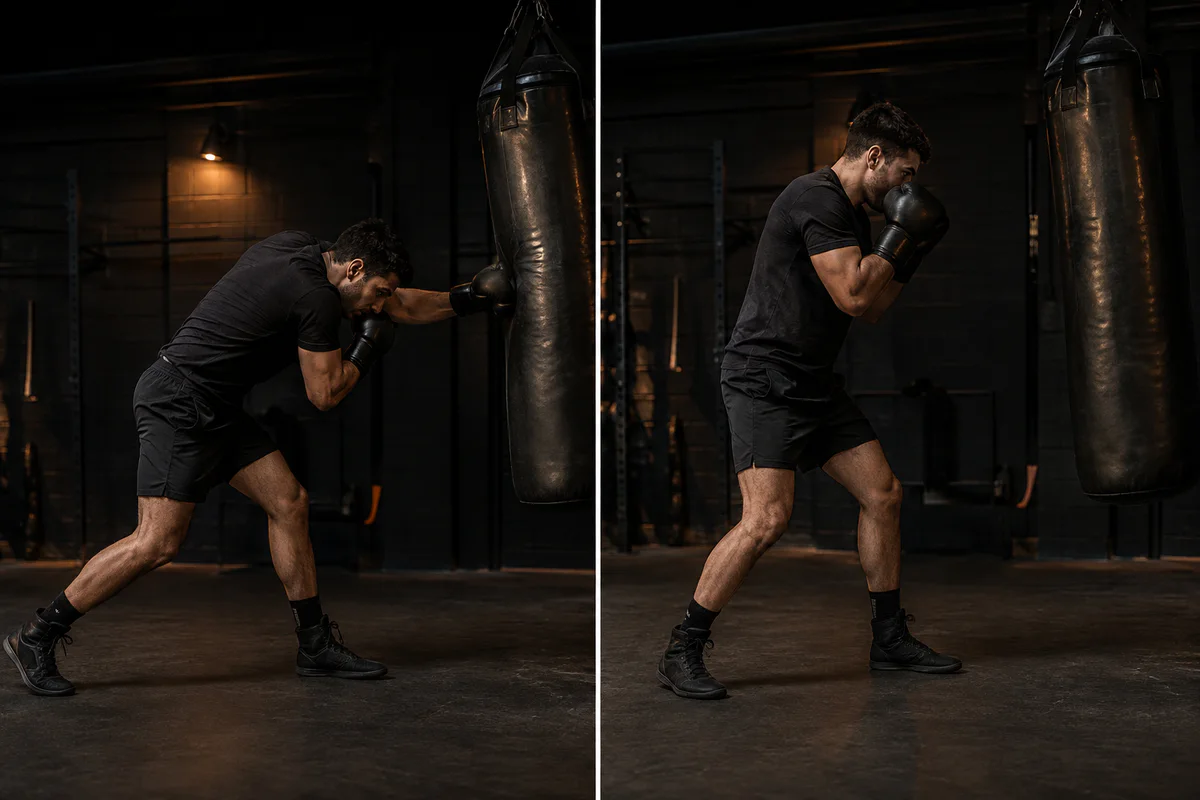
Record through the exit. A clip that stops at impact cannot show whether you needed a rescue step.
Use a side-front 45-degree angle. Frame your head, both gloves, hips, knees, feet, target, and enough floor for the exit. Record the bag at rest before the set. If the bag swings toward you, do not mistake the changing target distance for a change in your technique.
Pause the clip after every punch. Note your stance, distance, and ability to perform the next action. Follow the site’s video-review methodology to keep observations separate from explanations.
Find the first broken transition
You lose control on the entry
Practise the step into range without punching. Finish in a stance from which you can move again. Then add the jab. If the step already requires a recovery adjustment, the rest of the combination cannot repair it.
You reach on the middle punch
Test the jab-cross without the final hook. Move the target or starting point so you can complete both straights without chasing. Use the overreaching protocol if you cannot complete the planned next action after the cross.
You rotate through the final hook
Throw the lead hook alone at the range your coach selected. Plan the return and exit before initiation. Use the wide-hook protocol when the arc expands as you chase the bag.
You admire the work instead of exiting
Attach one defensive return or one step to the end of the sequence. The combination does not finish at contact. It finishes when you regain a usable boxing position.
Rebuild from the end backward
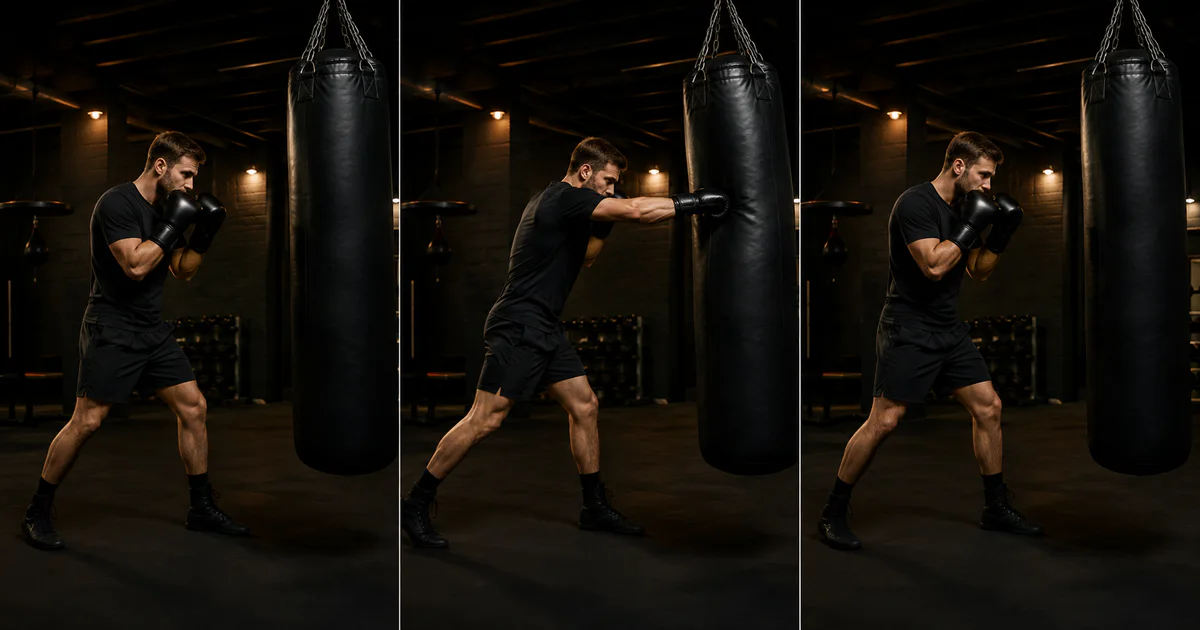
Establish the finish first. Add the final punch, then rebuild the rest of the combination without losing the planned exit.
Many boxers always practise combinations from punch one. For this problem, start with the final transition.
- Perform the final punch and exit.
- Add the preceding punch, then finish and exit.
- Add the first punch only after the shorter sequence remains controlled.
- Compare the same camera view after each layer.
Use this method to identify the added transition after which you change your recovery. Do not treat it as proof of a universal teaching sequence. Ask your coach whether they consider the drill suitable for your current level and style.
Use a recovery test instead of appearance
Choose one simple test after the final punch:
- take one controlled step backward;
- pivot away at a coach-approved angle;
- return both gloves and hold the stance briefly;
- perform one defensive action your coach selected.
If you cannot complete the test without catching yourself, reduce range, speed, or combination length. Do not aim merely to keep your torso upright. Aim to remain able to box.
What research can and cannot tell you
In the IBA Coaches Manual, IBA instructors introduce punches first in standing positions, then with steps, and finally in combinations. Use that progression to simplify a failing sequence.
Biomechanical studies of the cross, hook, and uppercut and lower-limb kinetics across punches describe whole-body contributions to punch output and stability. Laboratory force plates and motion sensors can measure variables that your phone cannot. Use video to compare visible positions, paths, timing, and recovery. Do not claim that it measured force transfer or balance physiology.
Compare fresh and fatigued sets without guessing
If you fall forward only later in a session, record the exact round, drill, intensity, and rest context. Researchers have reported fatigue-related changes in punch force and lower-body contributions, but you cannot use your individual clip to establish fatigue as the cause. You may also have changed distance, intent, or target movement.
Reduce intensity when coordination deteriorates. Stop if you feel pain, dizziness, confusion, visual disturbance, or unusual instability. Seek medical care when symptoms follow contact, persist, worsen, or concern you. The CDC concussion symptom guide explains the symptoms and danger signs that require urgent care.
Use Boxing AI to locate the first change
You can use Boxing AI to review visible punches, stance, defense, and footwork. You cannot use it to determine tactical intent that you did not provide, measure force, diagnose symptoms, or replace your coach.
Build a transition map
Map each transition instead of giving the whole combination one score:
| Transition | Intended position | Visible result | Keep or simplify |
|---|---|---|---|
| Entry to jab | In range with usable stance | Record what happened | Decide with coach |
| Jab to cross | Enough distance for rear straight | Record what happened | Decide with coach |
| Cross to hook | Correct range for selected hook | Record what happened | Decide with coach |
| Hook to exit | Ready for declared movement | Record what happened | Decide with coach |
Mark the first failed transition. Changes after that point may be consequences rather than separate causes. Retest the shorter sequence that ends immediately before the failure.
Include the bag’s movement in the record. A hanging bag can return toward you or swing away, changing distance during the combination. Use one controlled set with minimal bag swing before you interpret your body position.
Ask your coach whether your planned finish matches the tactical purpose. A committed entry may legitimately end closer than your baseline, but you still need a declared next action. Store tactical variations as separate tasks so you do not train an automated quality system to reject every purposeful change in position.
Recheck the corrected sequence on another day before you add pace. One successful slow repetition shows a possibility, not a stable skill.
Distinguish a planned entry from an uncontrolled finish
You may deliberately finish closer after an entry combination. That choice does not excuse an unplanned recovery, and a changed position does not automatically prove that you fell forward. Declare the finish before you record:
Finish A: close range, both hands assigned, ready to work
Finish B: one step outside the bag's return path
Finish C: coach-selected angle with immediate defense
Run only one finish during a set. After the last punch, perform the declared action without adding a rescue step. Record whether you completed it, changed it, or could not attempt it. Use this method to judge control without demanding that every combination end in the starting location.
Ask your coach to review a successful attempt and a typical failed attempt at normal speed. They can decide whether you committed position deliberately or lost the ability to continue. Keep that tactical judgment outside automated scoring and outside any single freeze frame.
Your pass standard
You pass when you can complete the declared combination and perform the planned exit across several controlled repetitions without an unplanned recovery step. Increase speed or complexity only after your coach accepts the sequence at technical pace.