
Training
Can You Learn Boxing by Yourself? What Solo Practice Can Teach
Learn which boxing skills you can practise alone, which video can only check partly, and which require a qualified coach or training partner.
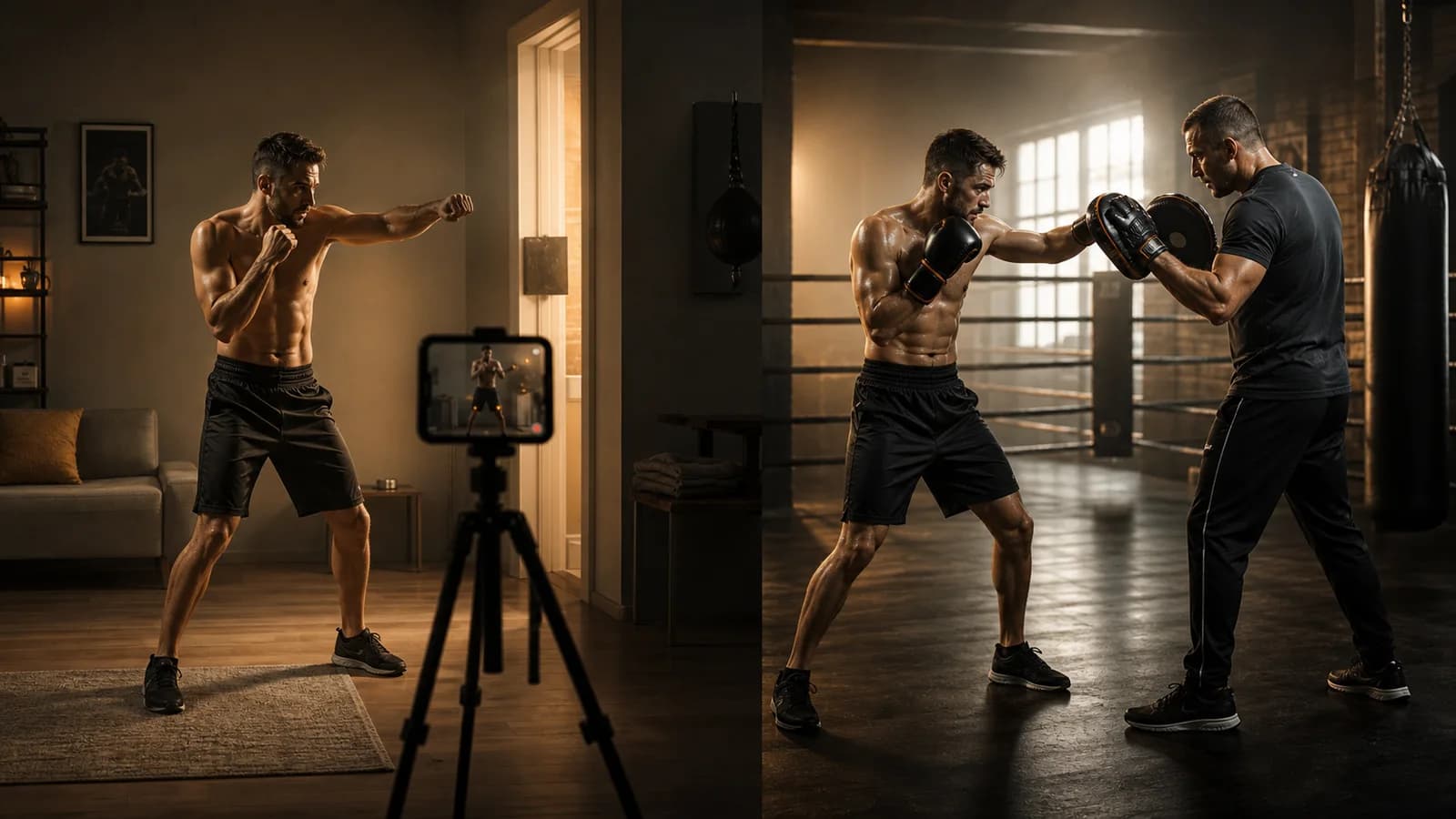
You can practise parts of boxing by yourself—stance, basic footwork patterns, shadowboxing, simple punches, conditioning, and video review—but you cannot learn the whole sport alone. Distance, timing against another person, defensive reactions, contact, tactics, and safe sparring require a qualified coach or suitable training partner. Use solo work to prepare better repetitions and questions, not to declare yourself fight-ready.
The distinction matters because boxing is an interaction. A movement can look organized in empty space and fail when another boxer changes the range, blocks, counters, or pressures you. The IBA Coaches Manual teaches stance, movement, attack, defense, and tactics as connected areas rather than isolated poses.
Divide boxing skills into three groups
| Group | Examples | Honest limit |
|---|---|---|
| Practise alone | stance resets, controlled steps, shadowboxing, basic conditioning | You can repeat the pattern, but repetition does not prove it works against a person |
| Check partly on video | balance, visible guard return, foot crossing, movement order | The camera only shows its angle; it cannot judge pressure, intent, pain, or real impact |
| Learn with a coach or partner | range, timing, partner defense, pad feedback, contact, sparring, tactics | Another person and qualified supervision create information solo practice cannot provide |
This split keeps solo training useful. It also stops you from treating every visible position as a complete verdict.
What you can practise alone
Start with the boxing stance guide. Rebuild your orthodox or southpaw position, take one small step, and return without crossing or joining your feet. You can practise direction changes, pivots at low speed, and a calm return to guard in a clear space.
You can also rehearse a jab, cross, and short combinations in shadowboxing. Use an imaginary target at believable range, avoid locking your elbows, and finish balanced enough to defend or move. The no-equipment drill session gives you six constrained rounds instead of random combinations.
General conditioning can support your practice: brisk walking or skipping where appropriate, controlled squats, incline push-ups, and short trunk-stability exercises. It does not automatically improve technique. Stop the conditioning block before fatigue prevents you from holding your stance or returning your hands.
What video can help you check
A stable clip can reveal visible events: whether your feet cross, whether the rear hand drops during a jab, whether you lean beyond your base, and whether you return to a defensive position. Film the full body from a front three-quarter angle and use a side view for posture or reach.
The video form-check method separates the start, action, and recovery. Compare the same drill, camera position, and approximate speed. Write one observation you can see—“my rear hand drops before the jab returns”—instead of a broad label such as “my boxing is bad.”
Video cannot measure true punch force, read an opponent, identify the cause of pain, diagnose injury, or prove that your movement will hold up under pressure. Slow motion makes sequence easier to inspect, but it can also make every decision look late. Watch at normal speed first.
What requires a coach or partner
You need another person to learn real range. A bag stays where it hangs and a mirror never counters. A partner changes distance, presents a target, reacts, feints, and forces you to decide. A qualified coach also sees the session from outside, selects an appropriate progression, and stops work that has become unsafe or unproductive.
Learn these areas in a reputable club:
- partner footwork and distance drills;
- correct use of focus mitts and the heavy bag;
- defense against an actual incoming action;
- controlled sparring with agreed intensity and protective rules;
- tactics, corner communication, and competition preparation.
Do not recruit an untrained friend for improvised sparring at home. Knowing a few combinations does not qualify either person to control contact or recognize a concussion.
Use solo practice between coached sessions
A practical beginner rhythm is one or two coached sessions plus one or two solo sessions each week. After coaching, write one movement task in the language your coach uses. Rehearse it slowly at home, film one round, then bring the question back.
For example:
- Your coach asks you to return the jab before stepping out.
- You practise that sequence in three short shadowboxing rounds.
- You record the final round from the same angle.
- You ask your coach whether the return and exit now connect correctly.
This loop gives solo work a purpose. The home-training system can structure the days without replacing the coached part.
How to choose a boxing gym
Look for coaches with recognized qualifications or affiliation, a clean training area, clear rules about contact, and a gradual beginner pathway. Watch whether trainers correct fundamentals before pushing speed. Ask how they introduce partner drills and sparring, what protective equipment they require, and how they respond when someone feels unwell.
For amateur competition, follow USA Boxing or the body governing your event. A coach, registration, medical clearance, matched opponent, and event rules form part of competition safety. A home practice log or video does not clear you to compete.
Stop when the question becomes medical
Do not use solo practice, video, or an app to explain pain, dizziness, headache, confusion, balance problems, vomiting, vision changes, or symptoms after a hit to the head. Stop and seek medical guidance. The CDC HEADS UP guidance lists concussion signs and symptoms; only an appropriate healthcare professional can assess you.
Bottom line: you can teach yourself a practice routine and rehearse visible fundamentals, but you cannot teach yourself the full interaction of boxing. Use solo rounds for repetition, video for narrow observations, and qualified coaching for distance, response, contact, tactics, and safe progression.